2025 Hyundai Venue Vs Tata Nexon: Which Sub-4m SUV Will You Pick?
- Nov 7, 2025
- Views : 2309



 Follow us

The acceptance of diesel vehicles has witnessed a rapid rise in the last decade in India. With the advent of new technologies such as common rail direct injection, EGR systems and exhaust treatment systems, diesels today offer great performance, excellent mileage and on many accounts it is the cleaner fuel! The inherent ability of diesel engines to produce excellent low end torque makes for great driving; however these factors basically aided diesel engines to gain an acceptance in the passenger car market as they didn't spew black smoke like in the past. The icing on the cake however has to do with the pricing of fuel. Assuming Diesel is priced at around Rs. 50/litre and petrol is approximately Rs. 70/litre. The rates change in different parts of the country; however the ratio of difference between the two is more or less the same. It is the cumulative knowledge of all these facts that make diesel engined passenger vehicles the number one choice for many customers, however there is a chink in the diesel armour and that has to do with the pricing of the vehicle as compared to its petrol counterpart.
A deeper insight is required while trying to decipher the cost benefit between diesel and petrol vehicle variants. Elements such as the timeline of usage, cost difference between the two models, fuel price disparity, maintenance expenses and service charges, parts wear and tear and depreciation costs sum up the major list to assist in calculating the actual benefit. It is a line of thought that most customers overlook, however our cost-benefit study should shed some light on the topic and hopefully help customers make a more informed decision, rather than just going with gut instinct or following the claims of manufacturers.
Note: The study is based under the following assumptions:
1. Costs of Petrol and diesel are for representational purposes only
2. The difference in price of petrol and diesel remains constant throughout the five years.
3. Cost of repairs and maintenance on both the variants remains nil or equal.
4. Both the variants will bring in 50% of the cost at the time of resale
5. Average driving is 15,000kms/year for both the variants. (in case 2)
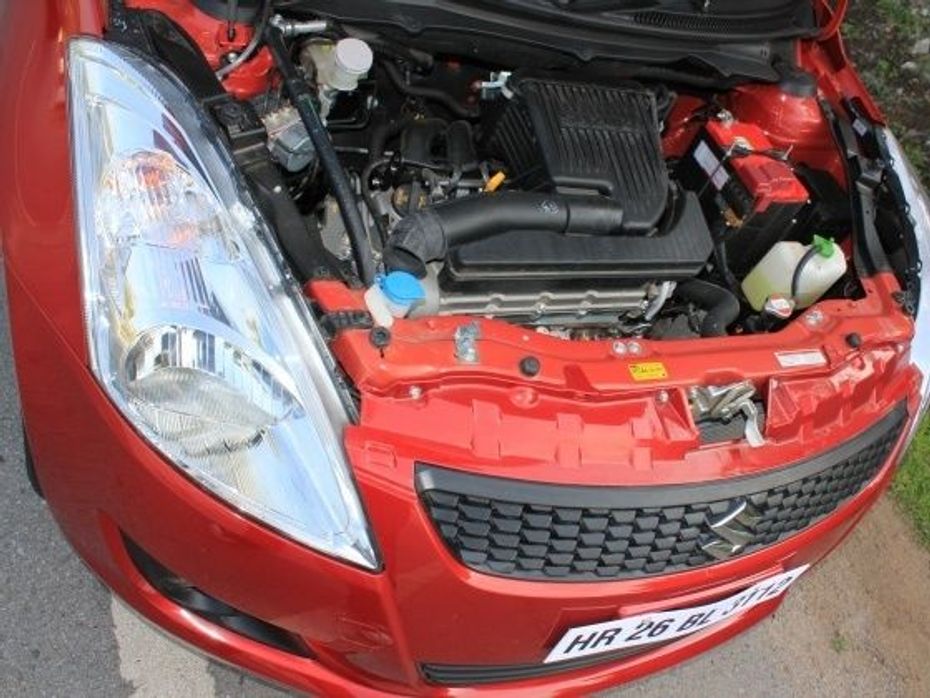
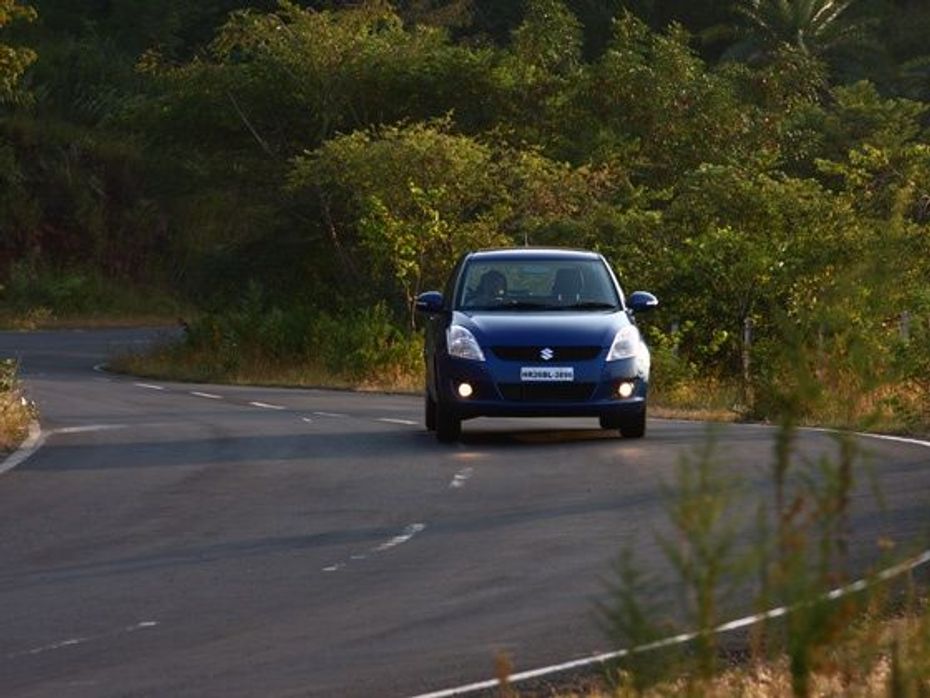
6. The car model under consideration is the new Maruti Suzuki Swift (entry level variants for both diesel and petrol). This is only indicative, and gives a good idea since the difference of cost between petrol and diesel variants of other cars also hovers around the same figure.
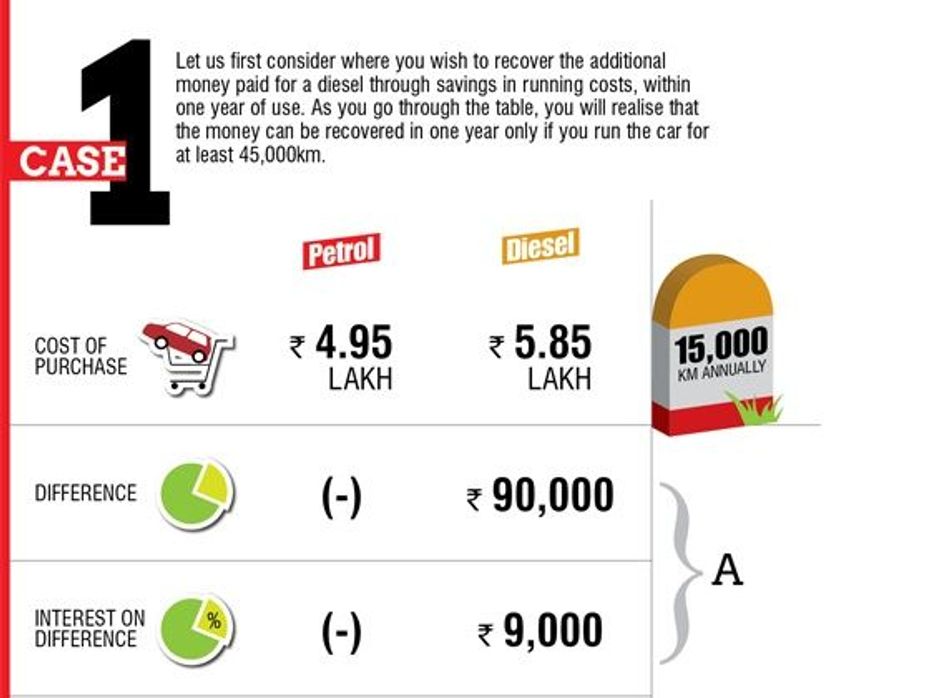
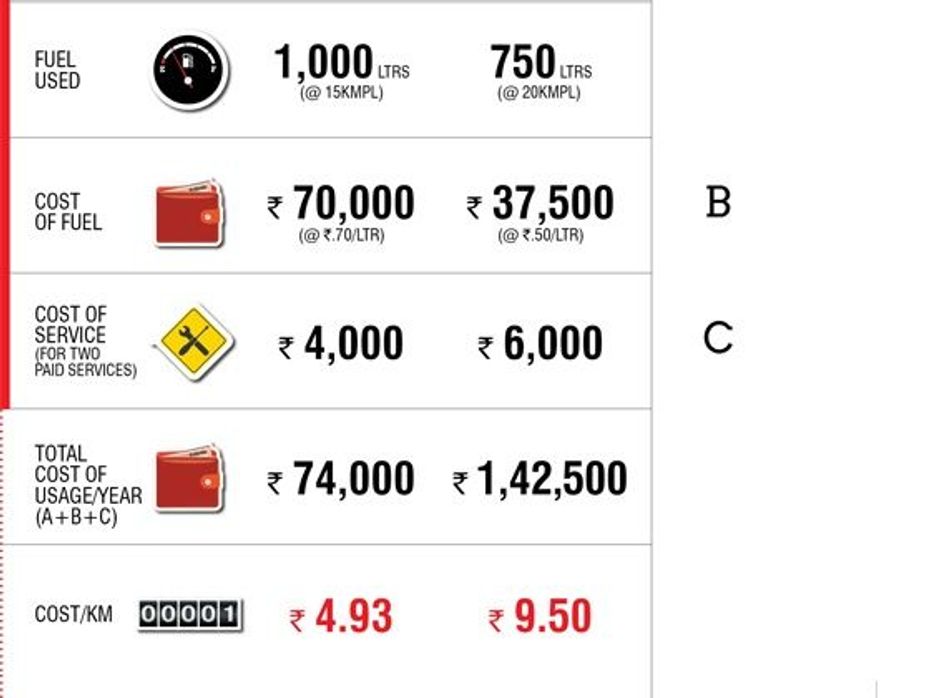
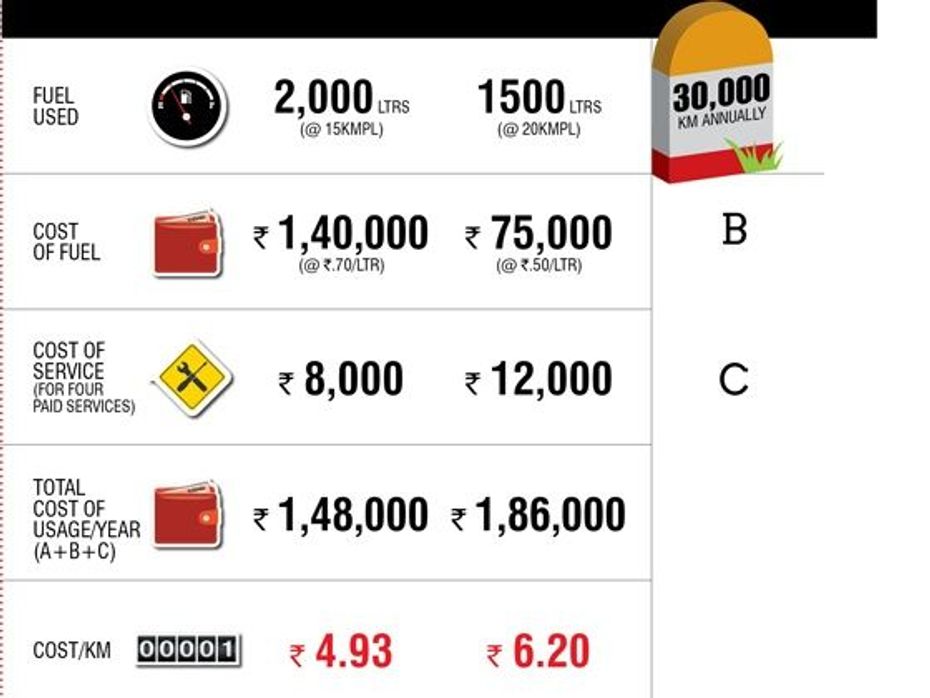
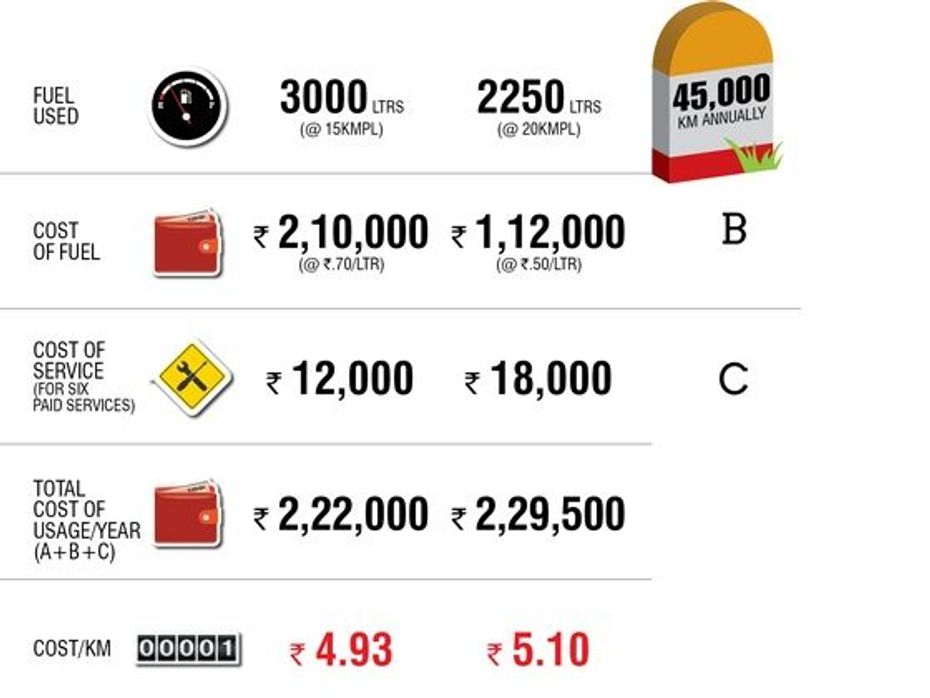
We did the math to compare the cost of operation for an entry level Maruti Suzuki Swift petrol with the diesel variant. The difference in the cost of the two variants is Rs. 90,000 with diesel being the more expensive of the two; add to that the interest one would gain on the excess amount at 10% p.a if the petrol variant was purchased. The diesel variant being more efficient and the cost of diesel being Rs. 20/litre lesser than that of petrol, it saves a lot of expenses on fuel (See Case 1), but the cost of regular maintenance of the diesel variant is higher than that of its petrol equivalent. Taking all these dynamics into account, the running cost of a petrol car comes to approximately Rs. 4.93/km in comparison to Rs. 9.5/km for the diesel if both the vehicles are run for 15000kms annually. Increasing the annual mileage put on the odometer, the diesel is at par with the petrol variant if and only if a person does a minimum of 45,000kms annually.
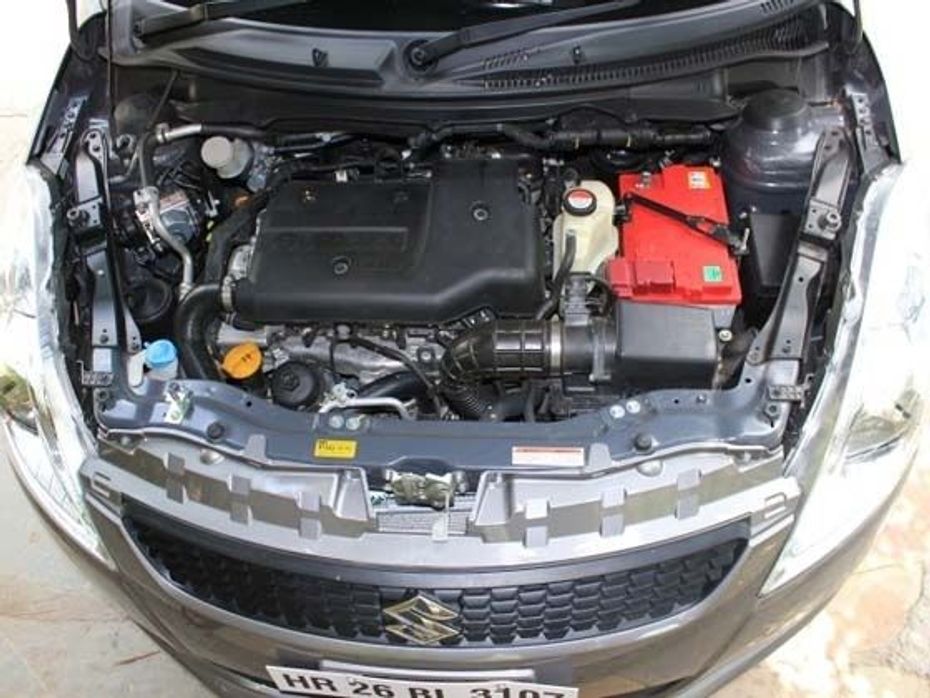
Low running? Wait for longer to recover costs
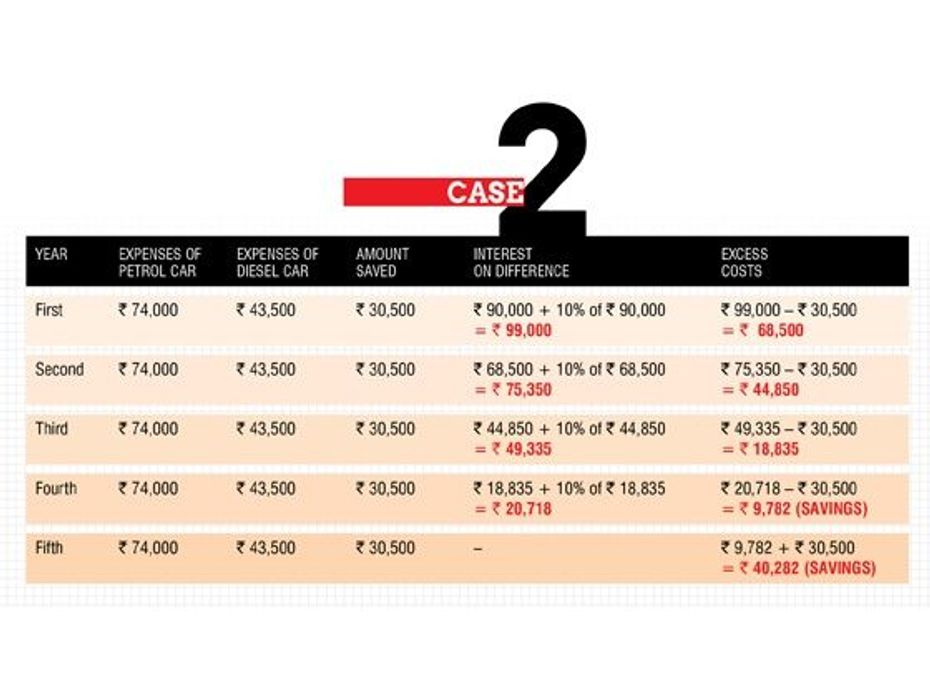
Now, it is understandable that an average Indian cannot put 45,000kms on the odometer annually considering the average run of an Indian being around 15,000kms per year. So does that totally rule out the diesel option? Well, no. Reverse calculating the amount of money saved on fuel (See: Case 2) by using a diesel car amounts to Rs. 30,500 annually after deduction of service costs for both the vehicles. Even so, after adding interest on the additional amount paid by a buyer at the time of purchase the diesel would be at par with the petrol variant mid-way through the third year. At the end of the fourth year with an annual running of 15,000kms, the money you would have saved in terms of running costs in a diesel would cover up the extra price you have paid, and you would have saved an extra Rs 9,700 as well. Only at the end of the fifth year do things begin to look rosy for diesels, with around Rs 40,000 saved in running costs over these five years.
What about depreciation?
Alright, so you finally made up the extra amount you spent in the initial invest of a diesel car, but what about depreciation? Assuming that both the variants have been reduced to half their cost after 5 years, you will still be losing more money in depreciation for the diesel, since it was a more expensive buy to start with.
The value of a Rs 4.95 lakh petrol car will be reduced by Rs 2.47 lakh at the end of five years. The value of a Rs 5.85 lakh diesel car on the other hand will be reduced by Rs 2.92 lakh – that’s Rs 45,000 lost straight in depreciation for a diesel.
This is an extreme scenario, we accept. The market dynamics for more-in-demand second hand diesel car space may result in lesser depreciation, and a better resale price. Either ways, the Rs 40,000 that a diesel user may gain after using the car for five years starts looking less rosy once you factor in depreciation as well.
Although, with the price of petrol is as high as Rs. 70/litre, the diesel may seem like a more affordable option, it may not necessarily be so. The diesel starts making economic sense for users who either have a run of 45,000kms annually or those who plan to retain the car for atleast five years or till the time they hit 50,000 kms on the odometer. And for those who have much less travelling to do in a car, the petrol still makes for a better buy.
What about the feel factor?
Although mathematics seem to be in favour of a petrol car unless you plan to retain a diesel for a prolonged period or drive seriously long distances within the first year itself, it is clear that the choice between petrols and diesels also has other angles that must be considered before making that final call.
Psychological satisfaction is of utmost importance to an Indian customer; and along with it comes the mental peace of not having to refuel a diesel car every few days unlike the petrol equal which is pretty much perpetually thirsty. But, simply the fact that the diesel needn’t be refueled very frequently doesn’t make it a more economical option. A diesel starts making sense only when you have a run of at least 15,000kms anything less than that and diesel will smartly fool you into feeling richer just because you end up filling fuel less frequently.
It is not just the thirst for fuel of petrol cars that brings diesel vehicles into the lime light. The numbers before you clearly state, that you should consider buying a diesel only if your monthly run exceeds a 1000 kilometres. In fact our thesis was endorsed by Toyota at the recent launch of the Etios and Liva diesels, where they made it very clear that for a diesel to start looking rosy; one has to run it for nearly 2000kms a month. The numbers are before you, so remember that with a diesel, you would still be paying that extra cash for the first three-four years of running for the satisfaction of driving a diesel. It still is a case of different strokes for different folks, and choice still remains in the hands of the buyer. Hope this article helps you make a more informed one.

2025 Hyundai Venue Vs Tata Nexon: Which Sub-4m SUV Will You Pick?
Skoda Kodiaq vs Volkswagen Tiguan R-Line: Full Comparison & Why...
Maruti Suzuki Victoris Vs Tata Curvv: Which SUV Offers More Value In...
Which Maruti SUV Should You Go For? Maruti Victoris vs Maruti Grand...
Maruti Suzuki Victoris vs Kia Seltos: Which Compact SUV Offers More...
Maruti Suzuki Victoris vs Maruti Suzuki Brezza: Which Maruti SUV...
Maruti Suzuki Victoris vs Hyundai Creta: Can The Newcomer Take On The...
Maruti Suzuki Victoris Vs Grand Vitara: Which Maruti SUV Deserves...
Hyundai Creta Vs Honda Elevate: Which Compact SUV Should You Pick?
Škoda DNA Tested | Kushaq & Octavia RS On Track! | ZigWheels.com
India's largest automotive community
Tesla Roadster
₹ 50.06 Lakh
Audi Q3
₹ 51.99 Lakh
Toyota Glanza
₹ 6.99 Lakh
Volvo EX90
₹ 1.26 Crore
Skoda Slavia
₹ 10.00 Lakh
 2026 Universo Ferrari Exhibition Highlights: F50, Luce, 12Cilindri & SF-26 2026 F1 Car Showcased!
 Ferrari’s First EV, The Luce, Unveiled In India: Love It Or Hate It?
 Renault Duster Hybrid Launched At Rs 16.99 Lakh! Most Powerful Hybrid In Its Class!
 All-New Audi Q3 Launched At Rs 51.99 Lakh! German Experience With Class-Leading Ride!
"Tesla Roadster Sucks" Says Elon Musk, Find Out Why
All-New Audi Q3 Launched At Rs 51.99 Lakh! German Experience With Class-Leading Ride!
"Tesla Roadster Sucks" Says Elon Musk, Find Out Why