














New Car
Explore all New Cars of 2024


 Follow us

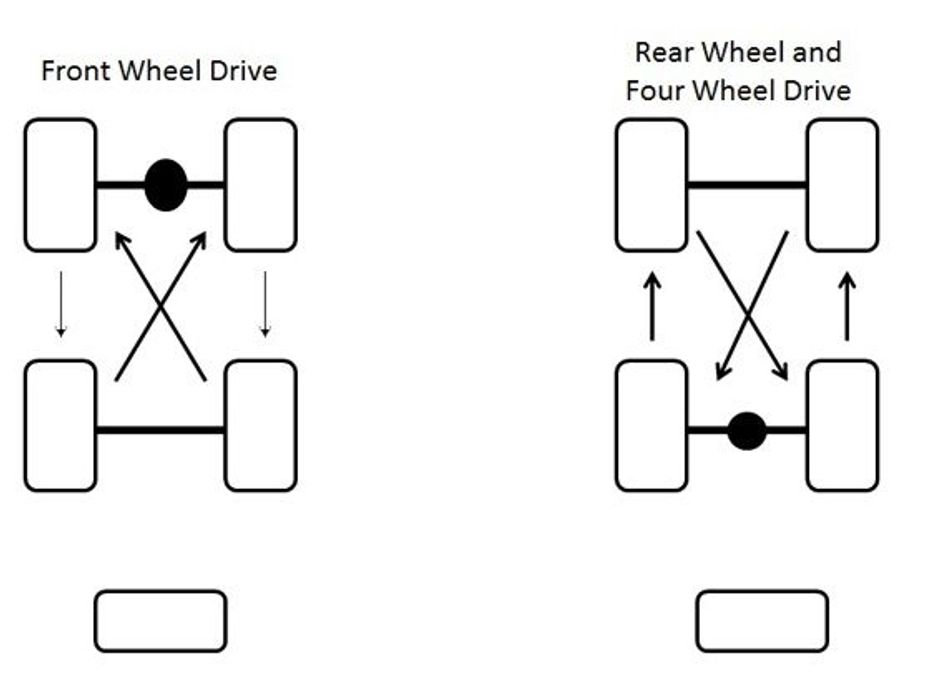
Four Wheel Rotation
The most common problem faced during tyre wear and tear is the wearing out of front tyres before the rear. In such cases, the two front tyres have to be either replaced with new ones or with the old, but partly worn out units at the rear. This is where tyre rotation comes into play. Here are two ways to rotate your car’s tyres.
1. Four Wheel Rotation: This method can be applied only when the running wheels are being used. Also, it cannot be done with a space-saver tyre (a smaller, limited-use spare tyre) provided by the manufacturer or if your car has a combination of tube and tubeless tyres. In this method of rotation, the front tyres go in the corresponding rear hubs and the rear tyres are put on the opposite front hub. For example, in two wheel drive cars, the rear right tyre will be moved to the left front and the right rear tyre to the left front. On four-wheel-drive cars, the front tyres are changed in a criss-cross pattern and the rear tyres shift to the corresponding front hubs.
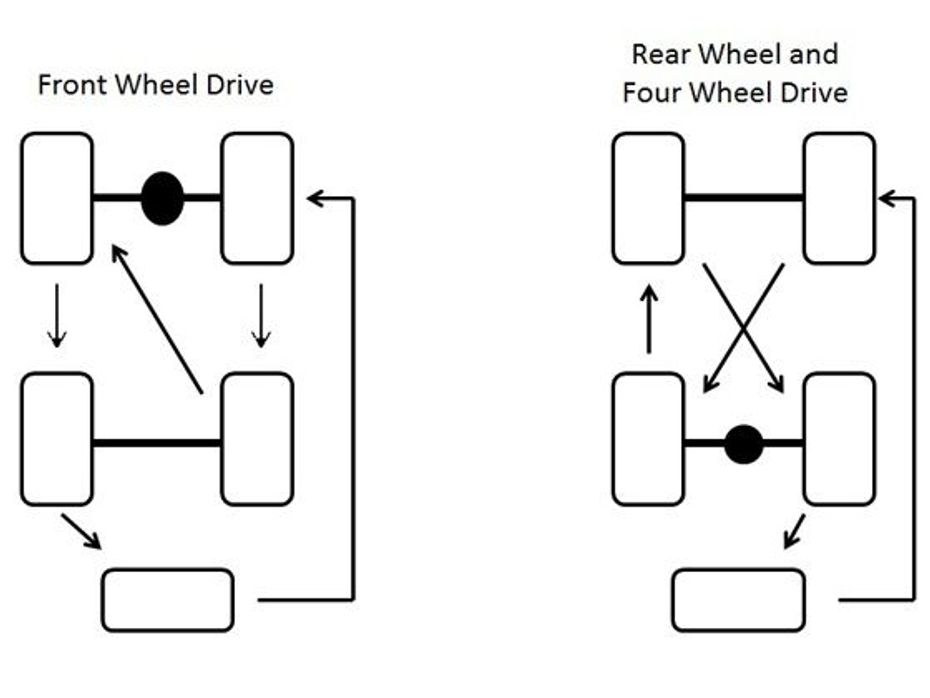
Five Wheel Rotation
2. Five Wheel Rotation: This method also uses the spare wheel and can be a bit tricky. The spare wheel goes to the front right hub and the front tyres go to the corresponding rear hubs. The right rear tyre will move to the front left hub and the rear left tyre comes out as the spare. In four-wheel or rear-wheel drive cars, the front tyres are shifted in a criss-cross fashion on to the rear hubs. The rear left tyre is fitted on the right front hub and the rear right tyre becomes the spare while the original spare moves to the front right hub.
Ideally, rotation of tyres needs to be done every 15,000kms. In the rotation cycle, where the spare wheel is also included, it's understood that the fifth wheel is also in an equally good condition as the other four tyres.
NOTE: If you have unidirectional tyres, you cannot swap them from left to right and vice versa unless you invert them face to face on the rim.
India's largest automotive community